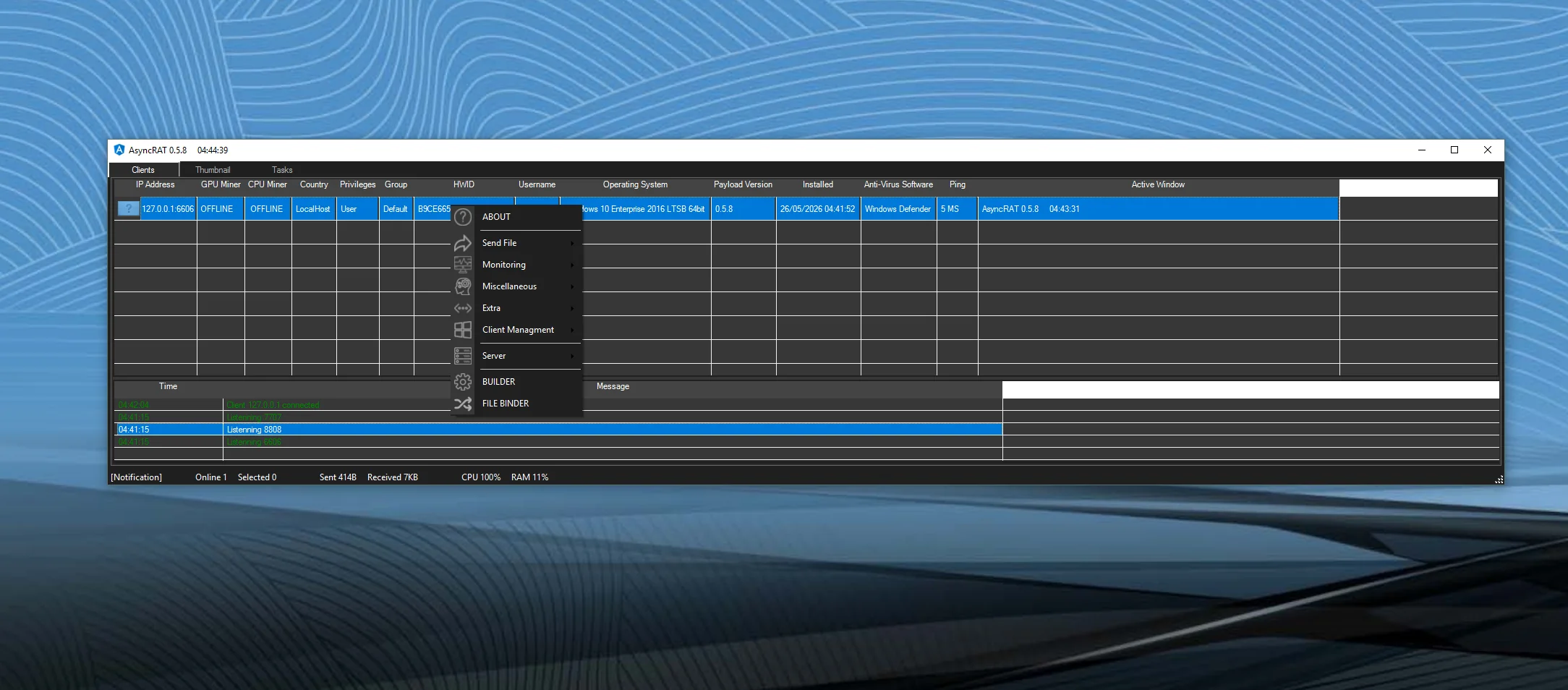
🛡️ Technical Deep Dive: Analyzing AsyncRAT v0.5.8 Cracked Features
In the modern cybersecurity landscape, Remote Access Trojans (RATs) continue to evolve into highly sophisticated malware frameworks capable of surveillance, credential theft, persistence, and remote system manipulation. Among these threats, AsyncRAT has emerged as one of the most widely discussed open-source RAT families used in cybercrime campaigns worldwide.
Although the original AsyncRAT project was introduced as a remote administration utility, modified and cracked versions such as AsyncRAT v0.5.8 are now frequently distributed across underground malware forums. Security researchers, SOC analysts, and incident response teams continue to study these variants to better understand attacker behavior, malware delivery methods, and defensive mitigation strategies.
This technical analysis explores the major capabilities, persistence techniques, monitoring functions, offensive modules, and detection methods associated with AsyncRAT v0.5.8 from a defensive cybersecurity perspective.
🚀 Delivery Mechanisms: To Memory vs. To Disk
Modern malware operations often begin with stealth-focused delivery techniques designed to evade traditional antivirus software and endpoint security tools. AsyncRAT v0.5.8 commonly relies on two primary execution methods.
🧠 1. Sending to Memory (Fileless Execution)
Fileless malware execution allows AsyncRAT to operate directly within system memory without writing malicious payloads to the hard drive. This technique significantly reduces forensic evidence and makes signature-based antivirus detection much more difficult.
🔹 Key Characteristics:
- 🛑 RAM-Based Payload Injection:
The malware injects malicious code directly into memory using PowerShell scripts, reflective DLL injection, or process hollowing techniques. Since no executable file is stored on disk, traditional antivirus scans may fail to detect the infection. - ⚡ Stealth and Evasion:
Fileless execution helps attackers avoid security monitoring tools that primarily scan files stored on the operating system. Threat actors often abuse trusted Windows utilities such asrundll32.exeor PowerShell to blend malicious activity with legitimate system processes. - 🔍 Detection Considerations:
SOC teams should monitor suspicious memory allocations, unusual PowerShell execution, and process injection behavior involving legitimate Windows processes likeexplorer.exeandsvchost.exe.
💾 2. Sending to Disk (Persistence)
In disk-based deployment, AsyncRAT stores executable payloads directly onto the infected machine. Although easier to detect compared to fileless execution, this method enables persistence after system restarts.
🔹 Common Persistence Locations:
- 📂
%AppData% - 📂
%Temp% - 📂
%Roaming%
🔹 Persistence Techniques:
- 🔑 Registry Run Keys:
AsyncRAT can create registry entries that automatically launch the malware whenever Windows starts. This ensures long-term persistence even after reboots. - ⏰ Scheduled Tasks:
Attackers frequently configure scheduled tasks to repeatedly execute malicious payloads in the background while remaining hidden from inexperienced users. - 🧬 Startup Folder Abuse:
Malware operators may copy payloads into Windows startup directories to guarantee automatic execution during user logins.
👁️ Monitoring Capabilities
After successful infection, AsyncRAT transforms the compromised system into a remote surveillance platform capable of monitoring user behavior, collecting sensitive data, and controlling system functions remotely.
🖥️ Remote Desktop (Screen Capture)
🔹 Surveillance Functionality:
- 📸 Real-Time Screen Monitoring:
AsyncRAT allows operators to capture screenshots or stream desktop activity from infected machines. This enables attackers to monitor confidential corporate activity, banking sessions, or administrative operations. - 🧩 Reconnaissance Collection:
Continuous screen monitoring helps attackers identify valuable systems, security software, and internal network information useful for lateral movement within enterprise environments. - 🔍 Detection Clues:
Security teams may identify abnormal usage of graphical APIs such asgdi32.dllduring forensic analysis or EDR monitoring.
⌨️ Keylogger
🔹 Credential Theft Operations:
- 🔑 Keystroke Recording:
AsyncRAT can silently capture every keyboard input entered by the victim, including usernames, passwords, email messages, and financial information. - 🧠 Session Monitoring:
Keylogging functionality enables attackers to collect authentication credentials for VPN platforms, enterprise dashboards, and cloud services. - 📡 Data Exfiltration:
Logged keystrokes are typically stored temporarily before being transmitted to attacker-controlled command-and-control infrastructure.
🔐 Password Recovery
🔹 Browser Credential Harvesting:
- 🌐 Saved Password Extraction:
AsyncRAT targets stored browser credentials from Chrome, Edge, and Firefox using credential recovery modules. - 🛡️ DPAPI Abuse:
Some variants abuse Windows Data Protection API (DPAPI) mechanisms to decrypt locally stored authentication information. - 🍪 Cookie and Session Theft:
In addition to passwords, attackers may steal browser cookies and session tokens to hijack authenticated web sessions.
📁 File Manager
🔹 Remote File Control:
- 📤 Upload and Download Operations:
Attackers can remotely transfer files between the victim machine and external infrastructure. - 🗂️ Directory Browsing:
The malware provides complete access to local file systems, enabling operators to search for valuable corporate documents and sensitive personal data. - ⚠️ Malicious Payload Delivery:
Threat actors may upload additional malware components such as ransomware loaders or data exfiltration tools.
⚙️ Process Manager
🔹 System Process Manipulation:
- 🧬 Process Enumeration:
AsyncRAT lists active system processes to help attackers identify antivirus software and monitoring tools. - ❌ Security Tool Termination:
Some variants attempt to terminate endpoint protection processes to weaken host defenses before deploying additional payloads. - 🔄 Code Injection Activity:
Malware operators may inject malicious code into legitimate Windows processes to evade security monitoring systems.
📊 Report Windows
🔹 Reconnaissance Collection:
- 🖥️ Open Window Enumeration:
Attackers can retrieve lists of currently active applications and windows running on the infected system. - 🕵️ User Activity Monitoring:
This information helps threat actors understand victim behavior and identify valuable enterprise applications.
📷 Webcam
🔹 Privacy and Espionage Risks:
- 🎥 Camera Access:
Some AsyncRAT variants may attempt to activate connected webcams for surveillance operations. - ⚠️ Corporate Privacy Threats:
Webcam abuse poses serious risks to executive privacy, remote workers, and sensitive business environments.
⚔️ Miscellaneous Offensive Modules
The miscellaneous modules within AsyncRAT v0.5.8 significantly increase its functionality, transforming it from a simple RAT into a broader cybercrime platform.
⛏️ Cryptojacking (Phoenix & XMR Miners)
🔹 Resource Exploitation:
- 💻 CPU and GPU Mining:
AsyncRAT may deploy cryptocurrency miners that abuse infected hardware resources to generate digital currency for attackers. - 🔥 Performance Degradation:
Victims often experience overheating, reduced system responsiveness, high electricity usage, and excessive fan activity. - 📉 Enterprise Impact:
Large-scale cryptojacking infections can increase operational costs and reduce workstation productivity across organizations.
🔌 Bot Killers & USB Spread
🔹 Malware Propagation:
- ☠️ Bot Killer Functionality:
Some variants terminate competing malware families to ensure exclusive control over infected systems. - 💾 USB Replication:
AsyncRAT may copy malicious payloads onto removable USB drives, enabling malware spread across isolated or restricted environments. - 🛡️ Security Concerns:
Organizations should implement removable media policies and disable unnecessary autorun features.
🌐 Seed Torrent (Abuse of Bandwidth)
🔹 Network Abuse:
- 📡 Unauthorized Torrent Seeding:
Compromised systems may be forced to seed torrent files without the victim’s knowledge or permission. - ⚠️ Bandwidth Consumption:
This activity can reduce network performance and potentially expose organizations to legal or compliance risks.
💻 Remote Shell & DoS Attack
🔹 Remote Administrative Abuse:
- 🖥️ Interactive Command Execution:
AsyncRAT may provide remote shell access through PowerShell or Command Prompt interfaces. - 🧨 Potential Post-Exploitation Activity:
Threat actors can use shell access for ransomware deployment, data theft, privilege escalation, or lateral movement. - 🌊 Network Flooding Risks:
Some variants contain denial-of-service modules capable of generating malicious traffic toward external targets.
🧩 Execute .NET Code
🔹 Dynamic Payload Execution:
- ⚙️ In-Memory .NET Execution:
AsyncRAT supports execution of dynamically compiled .NET code directly in memory. - 🧠 Advanced Malware Flexibility:
This capability allows operators to deploy additional post-exploitation utilities without dropping files onto the system.
🔎 File Searcher
🔹 Sensitive Data Discovery:
- 📂 Targeted File Scanning:
AsyncRAT searches for sensitive document types including spreadsheets, databases, PDFs, and password vaults. - 🏢 Intellectual Property Theft:
Corporate data, legal documents, and internal financial records are common targets during enterprise intrusions.
🎭 Extra Features for Operator Control
The “Extra” section focuses on user manipulation, sabotage, and fraudulent activity.
🌍 Visit Website
🔹 Traffic Manipulation:
- 📈 Artificial Web Traffic Generation:
Infected systems may be used to generate fraudulent advertisement clicks or increase page view metrics. - 🌐 Hidden Browser Activity:
Background browser sessions can silently consume bandwidth while monetizing compromised devices.
💬 Send MessageBox
🔹 Social Engineering Attacks:
- ⚠️ Fake System Warnings:
Attackers may display alarming pop-up messages designed to scare victims into contacting fraudulent support numbers. - 🎭 Psychological Manipulation:
Fear-based tactics are commonly used in tech support scams and phishing campaigns.
🗨️ Chat
🔹 Victim Interaction:
- 💬 Direct Communication:
Some variants allow attackers to interact directly with victims through chat windows. - 🎯 Scam Operations:
This functionality is sometimes abused in impersonation or fraudulent support operations.
🔓 Get Admin Privileges (UAC Bypass)
🔹 Privilege Escalation:
- 🛡️ Administrative Access Attempts:
AsyncRAT may attempt to bypass User Account Control protections to gain elevated privileges. - ⚠️ Expanded Attack Surface:
Administrator-level access increases the attacker’s ability to disable defenses and deploy additional malware.
🖤 Blank Screen
🔹 Concealment Techniques:
- 🖥️ Display Blackout:
Some variants can disable or darken the victim’s monitor while malicious activity occurs in the background. - 🕵️ Hidden Operations:
This technique reduces the likelihood of user interference during attacker activity.
🛑 Disable Windows Defender
🔹 Security Evasion:
- ⚠️ Defender Tampering:
Malware operators may attempt to disable real-time protection or modify security policies. - 🔍 Registry Modifications:
Security teams should monitor unauthorized changes involving Windows Defender registry keys and PowerShell security commands.
🖼️ Set Wallpaper
🔹 Psychological Impact:
- 📢 Visual Manipulation:
Attackers may replace desktop wallpapers with threatening messages, scam advertisements, or fake warnings. - 🎭 Fear and Intimidation:
This tactic is frequently associated with ransomware-style social engineering campaigns.
🛡️ Detection & Mitigation Strategies
SOC teams and incident responders should rely on behavioral analysis and layered security monitoring to detect AsyncRAT infections effectively.
🔍 1. Network Signatures
- 🌐 Monitor unusual outbound traffic patterns and encrypted communications.
- 📡 Investigate repeated beaconing behavior toward suspicious infrastructure.
- ⚠️ Analyze traffic using uncommon or dynamically changing ports.
⚙️ 2. Process Injection Monitoring
- 🧬 Detect suspicious
CreateRemoteThreadactivity. - 🔄 Monitor abnormal parent-child process relationships.
- 🛡️ Identify code injection attempts into trusted Windows processes.
🛑 3. Defender Tampering Detection
- 🔑 Alert on unauthorized registry modifications.
- ⚠️ Investigate attempts to disable security services or real-time protection.
- 🧠 Monitor PowerShell activity targeting endpoint security settings.
🧪 4. YARA Rules and Threat Hunting
- 🔍 Deploy YARA signatures for known AsyncRAT artifacts.
- 📊 Perform memory analysis and behavioral threat hunting.
- 🧠 Search for indicators associated with .NET malware families.
Download AsyncRAT v0.5.8 Cracked
Virus Total Report AsyncRAT v0.5.8 Cracked
https://www.virustotal.com/gui/file/9cc9d7d715618578c939484df11a1f6a540a4a3a7d9dfed3b03d52a29cb07eae✅ Conclusion
AsyncRAT v0.5.8 demonstrates how modern Remote Access Trojans have evolved into advanced cybercrime frameworks capable of espionage, credential theft, cryptojacking, persistence, and enterprise compromise. Its fileless execution techniques, modular design, and extensive surveillance capabilities make it a serious cybersecurity concern for businesses and individual users alike.
Organizations should strengthen endpoint detection, implement employee security awareness training, restrict unnecessary administrative privileges, and deploy advanced behavioral monitoring solutions to reduce exposure to modern RAT malware threats.
Understanding how AsyncRAT operates enables cybersecurity professionals, SOC analysts, and threat hunters to improve defensive visibility and respond more effectively to evolving malware campaigns.
❓ Frequently Asked Questions (FAQs)
🔹 What is AsyncRAT v0.5.8?
AsyncRAT v0.5.8 is a modified Remote Access Trojan that enables attackers to remotely monitor, control, and manipulate infected Windows systems through various surveillance and persistence techniques.
🔹 Is AsyncRAT considered dangerous malware?
Yes. AsyncRAT is considered a high-risk malware family because it supports credential theft, keylogging, fileless execution, webcam monitoring, and remote command execution.
🔹 How does AsyncRAT evade antivirus software?
AsyncRAT commonly uses fileless memory execution, process injection, obfuscation, and trusted Windows utilities to bypass traditional antivirus detection methods.
🔹 What are the signs of an AsyncRAT infection?
Common indicators include high CPU usage, suspicious PowerShell activity, unusual outbound network traffic, disabled antivirus protection, unexpected system slowdowns, and unauthorized remote access behavior.
🔹 Can AsyncRAT steal browser passwords?
Yes. Many AsyncRAT variants include browser credential harvesting modules capable of extracting saved passwords, cookies, and authentication sessions.
🔹 How can organizations protect against RAT malware?
Organizations should deploy EDR solutions, enforce multi-factor authentication, monitor PowerShell usage, train employees against phishing attacks, and implement strong endpoint security policies.
🔹 Why is fileless malware difficult to detect?
Fileless malware operates primarily in system memory instead of storing files on disk, making it harder for traditional signature-based antivirus tools to identify malicious activity.
🔹 What industries are commonly targeted by AsyncRAT campaigns?
AsyncRAT campaigns frequently target healthcare, finance, education, manufacturing, government agencies, and remote workforce environments due to their valuable data and infrastructure access.
⚠️ Disclaimer
This article is intended strictly for cybersecurity education, malware awareness, defensive security research, and threat analysis purposes only. Unauthorized use, deployment, or distribution of malware is illegal and may violate cybersecurity and computer crime laws in multiple countries including the United States and European Union regions.